Orientation Video
The Orientation Video was the first work a viewer encountered when visiting the installation To Feel Something That Was Not of Our World.
When I was seven years old, my mother read a book aloud to me titled Survive the Savage Sea (1973). It was the true story of the Robertsons, a family of farmers in England who sold all their possessions to buy a sailboat with the intent of sailing around the world for several years. In June 1972, the Robertsons lost their sailboat in a remote part of the Pacific Ocean when a pod of Orca smashed the hull, leaving the four adults and two children adrift for 38 days. After their inflatable life raft grew too leaky to be safe, they abandoned it for their nine-foot fiberglass dinghy, Ednamair, a vessel so small that with everyone aboard only six inches of the boat remained above the waterline. The family navigated to areas where they could collect rainwater and survived by finding ways to catch sea turtles, dorado, and flying fish until they were spotted and rescued by the crew of a Japanese fishing boat. Survive the Savage Sea, written by Dougal Robertson, the father, was published the following year, based on the logbook he kept while adrift.
I have been fixated on this story since childhood, rereading the book nearly every year. In 2011, I traveled to see the dinghy Ednamair in the National Maritime Museum of Cornwall, England, which houses all the remnants of the Robertson family’s ordeal. In May 2020, I wrote to Douglas Robertson, the family’s oldest son, to ask if he would agree to an interview as part of the project the artist intended to undertake that summer between June 15 – July 22, 2020, the time period corresponding to the 38 days of the Robertson family shipwreck. “We really should speak every day,” was Douglas Robertson’s response. “No one has ever done that before.”
This 38-day conversation took place across a series of daily recorded phone calls from my home in Berlin to Douglas Robertson’s home in London. Douglas and I discussed the details of each day’s events while his family were adrift, as well as deeper questions around the mental shift from rescue to survival, and the way invention and resourcefulness function in a situation where the stakes could not be higher. These accounts of ingenuity under pressure are central to the ongoing magnetism the story has for me, and connect to my own explorations of the relationship between creativity and constraint. As a way trying to understand the scale of the animals they hunted for food, I made life-size paper models of every animal the Robertsons caught and ate, often mailing them to Douglas for feedback and further discussion. The installation, To Feel Something That Was Not of Our World, invites viewers into a personal-museological exhibition of videos, sculptures, photographs, drawings, text message exchanges, archival press materials, artifact replicas, and excerpts from the nearly 50 hours of audio recordings.
There was particular resonance to the subject of a shipwreck at the end of the 2020, as so many people experienced isolated and uncertainty, unsure of what rescue and survival will require. The title of the exhibition is a phrase from one of the interviews, where Douglas expresses his feeling of disbelief at the sight of the ship that rescued them, refusing to believe it was possible even once the ship turned their way. When I asked him at what point he finally believed it, he answers, “The rope…To feel something that was not us, that was not of our world—that was so good.”
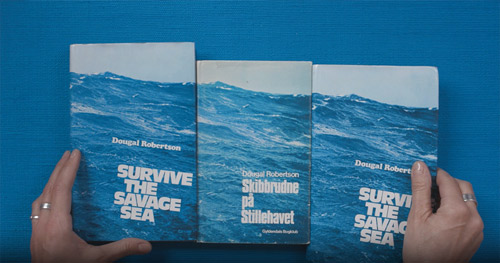
Orientation Video, 2021.